Showing posts with label Ramblings. Show all posts

Tuesday, January 6, 2015

The Tipping Point

It is no small thing to move to a new city and to get your head around it.  I have tried a few times to write about Barcelona, but I couldn't quite find my voice.  I know have written plenty about the places I've visited since I've started this blog, but this isn't a place I am visiting; I have moved my life here.

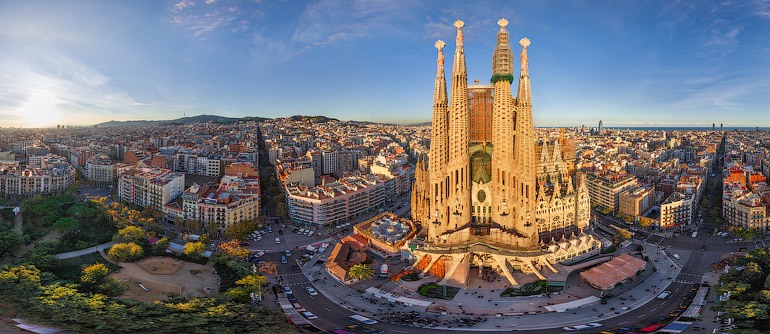
La Sagrada Famlia!  I have seen this once now, accidentally,
on my way to and from a bar (Photo Credit).
The problem of having a job in a new city...is that you have a job in a new city.  You are always fucking working.  You are in a totally different mindset, and unlike traveling, you cannot always find the time to experience the fullness of the city right away.  It is frustrating that in many ways, people who have visited Barcelona for a week (hell, a long weekend) know the city better than I do, even though I have lived here for months.  This is why I still struggle to answer when people from home ask me some pretty basic things, like:

"What do you normally do there?" 
or 
"What is Barcelona like?"  

The answer to the first question is probably a disappointment, because the expectation is that living in a foreign place, I will also be doing very foreign things.  But really, what I do is go to work and come home, tired, wanting to relax, and thinking about dinner.  Sometimes I go to the gym.  Glamorous, I know.  The answer to the 2nd question is usually a generic "It's cool!" because, well, it does seem to be a cool city.  But I lack in specifics because when I do get free time, it is very much still an exploratory process.  Far more often than finding or doing something cool in the city, I am confused about where exactly I am and the curmudgeon that lives inside me speaks up to wonder why I am in this new and distant restaurant or bar when there are plenty of other good ones that I already know about and are closer to where I live.

This was my metro stop when I first arrived to the city.  It is a
testament to Barcelona that the mundane aspects of my day
can look like this.
But there is a tipping point.  The longer you stay in a place, the more that place bleeds into your routines, and the more it will begin to populate your thoughts with its features and landscape.  I no longer look forward to going for a run.  I look forward to going for a run with my girlfriend, Jess, along the boardwalk in Barceloneta at sunset.  I don't ask for a Durum Kebap and a beer at the Doner place by my apartment anymore, but rather the waiter will ask me, "So, a chicken Durum and an Estrella?" when I sit down.  And when I stick my nose into my book on the bus/metro ride home, it is a new series of stops, starts, dings, and announcements that provide the cadence for whatever adventures, tales, ideas, or histories I am reading.

There is a deeper understanding of a city, country, or culture that comes with more time spent there, and it will begin to change you.  Slowly at first, and then all at once.  "How has this happened?" you will ask, "Was it the place?"  Yes, it was the place.  You have come to know this place in ways that a tourist cannot, and this broadening of your world cannot be undone. It has changed the way you see things.  "Was it the people?" you will extend.  Yes, it has most certainly also been the people.  The people are the best part, and will stay with you forever.  It has already become, in fact, impossible to separate the people and the place.  They reside in the same parts of your mind.  "Was it me?" you will lastly inquire.  Yes, it was above all else you.  Because in order for this to have occurred, you must have let it.  This is the hard part, because some places can be pretty weird.  And scary.  This doesn't mean you have become weird and scary (though it's a distinct possibility), just that you have come to accept a place for what it is, without your own expectations distorting it.

And then a funny thing happens: you will hear the same questions about the city as before, and you will still have a hard time answering.  "What is it like there?" people will ask.  "Where do I begin?" you will say.

I can feel it happening.

Monday, September 8, 2014

The sea's only gifts are harsh blows, and occasionally, the chance to feel strong.

I had every good intention of posting regularly in this blog over the summer; I really did.  But time slipped away, as it does, and now September finds me writing from a new home.  More on that later.  First, I would like to describe the very nonlinear (and honestly rather nonsensical) path I have traveled since my last post to get me here.  From Ecuador, to Bolivia, to Chile, to Maryland, to Iceland, and to Spain.  It was as epic and exhausting as it sounds, and the most exciting part was the first night I slept in my new bed in Barcelona.  There is a lot to catch up on, so let's get on with the first installment:

LAST HURRAH IN ECUADOR

Montañita

Cocktail Alley
One of the things I will miss most about living in Ecuador is its beaches.  They are accessible and clean.  The ocean is warm, as far as oceans go, and the weather is typically suitable year-round.  You can be completely isolated or in the midst of a raucous party, depending on your mood and your willingness to walk for about 10 or 15 minutes.  The equatorial sun is a monster, but there are bamboo huts and hammocks in abundance.  For me, the beach that most exemplifies all of these things is Montañita .  It is known as a party beach around Ecuador, and it certainly is.  Its main strip, after all, is called Cocktail Alley.  Dozens of wooden kiosks populate either side of the brick and sand street, each one with a thick lining of cheap liquor and fresh fruit covering their walls and counters.  To get started here, one must simply walk down the street, find the least offensive volume of reggae-ton for conversation, and have a seat at the plastic lawn furniture that can be found in front of each kiosk.  You will place your order, and after a frenzied clatter of blending and banging that seems to accomplish nothing for about 10 minutes, you will have a full-pint Mojito.  Or Caiparñia.  Or Maragarita.  For $2.50.  Is the liquor watered down on Cocktail Alley?  Probably.  Does it attract some oddball lifers and creepy drunks?  Yes.  But it also happens to be amazing.

The main stretch of beach by Cocktail Alley

All of that said, that's not why I kept returning to Montañita , and why for my last trip while living in the country I decided to go there for close to a week.  Just down the beach from the town proper, a 15 minute walk to the north, is an area called La Punta.  The Point.  This is where the cliffs momentarily win the battle against the shore, and the beach reaches a rocky end.  Up above these cliffs is the structure that gives Montañita  its name: Little Mountain.  It is a very distinguishable spire of rock that climbs towards the sky on the top of an otherwise flat cliff.  The surfers and hippies who used to be the only visitors to this beach started calling it this, and it stuck.  For surfers, Montañita is still one of the top destinations in South America.  For us non-surfers, it is still a beautiful, wide, sandy beach.  The waves can get massive further out, and the rip tide is dangerous if you aren't expecting it, or if aren't used to being in the ocean.  Closer in, though, is a wave-catchers dream.  Having grown up on the east coast of the US and being accustomed to summer trips to the mid-Atlantic beaches, the ocean for me is all about riding waves.  No board, no formalities...just finding the point at which the wave will break and assuming the Superman position as it would take me in towards the shore.  You get slammed, you get flipped, and you get a ton of water up your nose.  And you feel like you are a 12-year old kid again, grinning like an invincible moron every time you stand back up.  When you decide to leave the ocean, your age will return to you in the form of soreness and a weird popping sound that you don't remember having in your foot...but it will seem to matter much less than what just happened.


View of the "montañita" from the patio of Hostal SoleMare.
No crowds, and just a short walk from town.
There are a few really cool hostels at this end of the beach, especially Casa del Sol.  Depending on the season, rooms are $15-$20 per person, even for a single.  Breakfast is included.  They also offer yoga classes, Spanish lessons, and a beach bar at which I traditionally rack up a nice little tab.  On this most recent trip, my friends and I stayed across the street at the also-lovely SoleMare, due to a yoga retreat filling up Casa del Sol.  There are a few restaurants nearby (at which I encourage you to order anything that has "enconcado" written next to it), as well as a micro-brewery that is really, really good.  The trip passed as most trips to the beach do: friends, nights out, sunny days, and the kind of general enjoyment that honestly makes for pretty lousy stories.  I was there for a glorious 4 days, and I left on a Saturday so that I could get back to Quito and pack for my flight to La Paz on Sunday night.


Competition is getting ugly...

The title of this post is a quote from Primo Levi that I have always loved.  I think about it pretty much every time I'm in the ocean getting smacked around, throwing myself into, over, and under the relentless surf.  The quote continues, "I also know in life how important it is not necessarily to be strong but to feel strong."  Traveling and pushing my comfort zone are things that make me feel strong.  Let me rephrase.  Traveling and pushing my comfort zone make me feel like a bumbling idiot.  But after awhile, once I get through the awkward stage, I feel changed, like I'm a better version of myself.  Who knows if I really am, or what that means.  But to quote another really smart guy, "there is nothing either good or bad, but thinking makes it so."  So perhaps I'm chipping away a little at the reasons why I feel the need to live abroad and attempt to turn every distant, proverbial stone.  Like the ocean, the world will often hint that it could swallow me whole if I were to turn my back on it for just a second.  But like battling those waves, living like this has allowed me to interact with something much bigger than myself on a scale I can handle.  And that makes me feel good, and it helps me to learn a lot about myself and about the world without being consumed by it.  As it turns out, then, this is quite simply my own slightly foolish, periodically beautiful, and outrageously expensive self-help book.  It's way longer than it needs to be, and none of this would have happened if Borders hadn't closed.

That will about wrap it up for Montañita and my ramblings thereof...to be continued with:

La Paz and the League of Sinister Shoe Shinists (Working Title)
Photo Credit


Saturday, March 29, 2014

I Do Not Offer the Old Smooth Prizes, But Offer Rough New Prizes

Climbing is hard.  Often, it downright sucks.  At high elevations, you don't feel like yourself.  Your body doesn't really respond properly to your brain's commands.  This even though you are decently acclimatized from living in Quito at 2,800 m/9,500 ft, and find yourself on mountains regularly.  The weather almost never cooperates, and still in the best of conditions you consistently find yourself too hot and yet freezing cold at the same time.  Comfort does not, as a concept or a reality, exist here.  So, a very natural and very difficult question that I have both heard from others and asked myself many times is 'why on earth do you do this?'

On Imbarura, our idealism would soon be shattered.
Photo courtesy of Jamie Bacigalupo.
First of all, I am not a masochist; there is no pleasure in my pain.  The pleasure comes when the pain ends at the summit.  The summit comes after having cursed for hours, loudly and frequently, about my life choices that brought me to that mountain. Due to low oxygen levels, it's possible that the cursing is only in my head, and all that escapes my mouth is an exaggerated, communicative pant.  This is how I climb.  Based on this very unromantic reality of dragging my ass straight up an unrelenting slope of a mountain for hours on end, I can only conclude that one of the primary reasons I continue to climb has to do with the limitations of memory.  We are simply not capable of remembering pain, be it physical, emotional, or both.  We of course remember THAT something hurt, but we cannot conjure the actual feeling that we experienced.  We can imagine it a bit, but we do not really remember.  And this is a good thing; otherwise, think of what cowering and panicky creatures we would all become after a few decades on this planet.  Anyone who could remember these things too vividly would almost certainly remain always at home as a vegetative, fetal lump, and therefore unlikely to pass on their genetic material.  Because this is not the case for most of us, we are the beneficiaries of our imperfect memory.  We continue to do irrational and probably harmful things, like living in Kazakhstan during the winter, or cooking bacon in our underwear.  Or falling in love.  Or climbing mountains.  

Stopping on the slope to take in a view
But this alone cannot explain my motivation to climb mountains.  What is the appeal?  There are two reasons I have been able to come up with:  the challenge and the discovery of it.  I am not convinced that this is a comprehensive description, but hey, we all live with uncertainty.  Deal with it.  

The obvious physical challenge of climbing is appealing as someone who has always played sports, enjoys the outdoors, and likes to stay in shape.  The psychological element, however, is less understood.  Am I conquering nature by reaching the top of this ancient and savage pile of rocks?  I don't think so.  The knowledge that at any point I can just stop, turn around, and walk home can become seductive.  I think that conquering this impulse to stop when things get hard is a more accurate view.  I also feel it is a way to both create and address a problem that can be solved.  Just get to the top.  In normal life, the solutions to our problems tend to be more complex.  Or perhaps we cannot find a good solution at all.  The mountain becomes a simplified effigy of these problems, and one that can be overcome with the single-minded, straightforward method of putting one foot in front of the other, and throwing all of our energy into the task at hand.  It's a little like making a list of the things we have to do, and including 'eat pancakes' along with more formidable tasks, such as 'find a job.'  Even though it is a small act, there is great satisfaction that comes when you can cross it off of your list and say 'Hey, I'm halfway done!'  Come to think of it, maybe I should stop climbing mountains and eat more pancakes.  

Cloudy days offer their own beauty
These mountains are also about discovery.  You know, in the Christopher Columbus sense; you discover them for yourself (unlike Columbus, please do not try to rename landmarks in your honor, claim the mountain for Spain, or participate in genocide).  There is no replacement for experience.  Reading about places and listening to stories have given me countless hours of enjoyment, but it is just not the same as going somewhere.  If it were, there would be no difference between travel blogs and traveling.  This impulse to discover things for myself has had both positive and negative manifestations, and the jury is still out on its overall utility.  Regardless, I am living in South America because of it, and by extension, climbing mountains because of it.  Pushing myself to my physical and mental limits has resulted in a good amount of self-knowledge as well, when I can reflect honestly on the experience.  There is also something else...something more basic that comes with going out to a mountain in the middle of nowhere.  I've always failed at putting this part into words, but this may be what Walt Whitman was talking about in Song of the Open Road:
Walt Whitman Photo Credit

"The earth never tires,
the earth is rude, silent, incomprehensible at first,
Nature is rude and incomprehensible at first,
Be not discouraged, keep on, there are divine things well-envelop'd,
I swear to you there are divine things more beautiful than words can tell"

I wouldn't say that I am looking for spirituality on mountains.  But when I can pause and look around and see the world below mixed in with the clouds, when I can smell the earth and hear only my own two feet shuffling through the knee-high grass in an otherwise silent world, when I find that my constantly racing mind has for a moment stopped trying to figure everything out, I feel very much at peace.  

The reflections from this blog post were brought to you by Imbabura, a giant, extinct volcano near Otavalo in the very north of Ecuador.  If you are in Quito and want to start exploring the surrounding mountains a bit, I highly recommend booking with Paypahausi.  They provide guides, transportation, and some high-energy snacks (though you will probably want to pack something more to eat) for $45.  The schedule they follow resets every couple of months, and is designed to prepare climbers for Cotopaxi.  However, you can join for as few or as many trips as you want.  It is also a great way to practice Spanish and to meet fellow climbers!  

Photo Credit


Tuesday, March 11, 2014

Getting the Travel Bug

In 2008, my then-girlfriend Lisa and I took a massive trip around the world.  It went something like this: Ireland, Scotland, Spain, France, Italy, Belgium, Netherlands, Germany, Austria, Hungary, Greece, Cyprus, Egypt, Tanzania, South Africa, Australia, and Fiji.  Discounting a trip to Niagara Falls, I had never before traveled outside of my home country (no offense, Canada; it was lovely, but not so very foreign).  Sixty-some days and 3 continents later, I returned home to Maryland with the experience of a lifetime.  More traveling and a plan to leave the US for a longer period ensued, and by 2010 I was living in Ecuador.  My traveling has become less intense and more localized to South America of late, but a recent three week trip to Hong Kong made me reflect once again on the highs and lows of large-scale international travel.  And, because it is never too early to rehash old material, I would like to share a few of my thoughts on traveling from 2008, as I stand by them now, almost six years later:


Hey Barcelona, see you again soon!
You know how sometimes you wake up in the morning and are incredibly confused? You don't know where you are, how you got there, or what time of day it is? This is what happened to me the very first morning that I had returned from my trip around the world. For 2 months of traveling, I was fine; it took coming home and sleeping in my own bed to feel lost. This may have been because I didn't go to sleep until 3 AM and woke up at 7 AM to go to work. Or, it could have been because I was on Fiji time, and therefore the sun had inexplicably risen through the window at what was 11 PM on my body and mind. But I think the real reason was that for the first time all summer, I was able to let my guard down completely and not worry about my surroundings. That is one of the many true comforts of home. As a result, I awoke from the deepest sleep in months...to go directly to work. Oh well.


My sister, Ethel, met us along the way!
Traveling is equal parts motion and waiting. Whether we were waiting at the train station, airport, or hotel lobby, we found plenty of time on our hands, but only when we didn't need it and couldn't use it. Sometimes we were in motion and still waiting, such as waiting for the train to finally reach its destination. The point is that all of this idle time on my hands allowed for a wandering mind, and I would like to share some of these inner ramblings with you now. 
Anonymous train ride to somewhere


Apparently, the peaches in Rome are the best things on earth.


At any given point in time, the entire human race is mere hours away from starvation. Not deadly starvation, mind you, but certainly severe and crippling hanger. Food consumes a traveler's thoughts far more frequently a traveler actually gets to consume food. Because food can be expensive and because it is not always conveniently available, this at times becomes a very limiting nuisance. We were working inside of 5-6 hour windows to explore a city before having to worry about food again. In the course of 7-9 foodless hours, Lisa and I were reduced, on several occasions, to single-minded, zombie-like scavengers who stopped caring about cost, taste, and/or personal hygiene until we had something in our stomachs. Due to budgetary constraints and the ridiculous cost of living in Europe, we tried several tactics to combat our impulses. First, we tried to drink a lot of water to trick our stomachs into feeling full, but that only delayed things for an hour, tops. We then tried to gorge ourselves and eat as much as we possibly could in one sitting whenever we found a cheap restaurant or grocery store. The idea here was that we could store up on energy for a prolonged period of time, but the reality was more urgent and violent trips to the bathroom. Our final strategy before giving in to nature was to try to sleep late, miss breakfast, and eat only 2 meals a day. This was an act of pure desperation and resulted in really big, accidentally expensive lunches, not to mention the lost time. The only realistic thing that we could do was to ransack convenience stores for unsatisfying little snacks and buy spaghetti as often as we could because we got 2 meals out of one box. But even when we found food and were pleasantly full, there was still a little bug in the back of my head telling me, "Okay, you just bought yourself some time, but don't get cocky; in a few hours you'll be nothing more than a walking digestive system again." As a result, Lisa and I spent some of our airport waiting time assembling a detailed grocery list for when we got home. Aside from family and friends, the most exciting part of being back has been the refrigerator.
Datoga men in Tanzania

A self-reinforcing cycle of smiles in Tanzania
Comfort is a seductress. This was especially true in Cairo, Egypt when Lisa and I enjoyed the lovely home of our friends Jill and Terry after our hobo-like existence through Europe's hostels and train stations. After a month of longing for a hot shower and clean bed and often finding neither, we were flung into the unequaled luxury of a huge, fully stocked apartment. All of a sudden, we had our very own bedroom, kitchen, computer, laundry room, and living room complete with a big-screen TV and broad selection of DVDs. Our plans for all the places we wanted to see during our five-day stint in Cairo eroded into the 3 basics of the pyramids, the museum, and the Khan al Khalili marketplace. Even for the wonders of the world, it was a struggle to bring ourselves to leave the air-conditioned bliss for the smothering heat of Cairo's July sun. Every morning we stayed in bed just a little longer than planned. We hit the snooze button three, four, five times before giving up and resetting it for an hour later, letting the warm arms of sleep pull us back down under the covers. Every movie we started was a little too good to turn off or pause before the end, and the afternoons dissolved away. Every evening while eating our dinner delivered to our door by Chili's (don't judge us), we discussed how the next day we would get an early start and actually leave the apartment. We knew we were in Egypt and we knew that it would be a long time if we ever got back there, but after over a month of traveling, our most compelling desire was for a small dose of normalcy while it was for the taking. Just a little bit of comfort. We didn't know when we'd have it again, as we still had a month before returning home. Comfort can certainly be a trap if allowed to consistently decide one's actions, but sometimes it's as necessary as food (see previous paragraph).


Coast of Simonstown, South Africa


Traveling gives the peculiar sense of slipping through parallel universes. People and the basic rules that govern life are the same everywhere you go, but all of the little things change, as if the fabled butterfly had flapped its wings just a little differently. This is compounded by the fact that when traveling nowadays, people don't experience this shift gradually; they get into some kind of moving, mechanical apparatus, lock themselves in for a few hours, and when they get out, things are different. You get into an airplane and five hours later, people have accents (or perhaps more accurately you have one). You board a train and four hours later there's a different face on the money and some ludicrous number like 10,000 next to it that buys you a tube of toothpaste. Another airplane and a few hours and men wear skirts and women shave their heads. But in each place, the people remain essentially the same. A laugh is a laugh. People congregate around food, whether it's a restaurant, a marketplace, or a barbecue. They flirt.  They wheel, deal, and hustle. The differences are mainly in the how, not the what. What people do, say, want, and need, all remain the fundamentally the same.


Sunrise over False Bay, South Africa
Life is all about routine, even while traveling to places you've never been before. Our routine was to settle ourselves into our new surroundings and learn the new ways of saying hello, thank you, and goodbye. I must know that series of salutations in 8 languages now. We would check into our room, lock up our valuables, and consult either our map or the locals to get ourselves a good meal. We would then explore the town, city, or wilderness for what was left of the day and then return to our dwelling at nightfall. We would sleep. We would wake up, repack our bags that we had tried our best to keep intact, and then say goodbye to the place we had just met in whatever dialect we had just learned. Even as we moved on to the excitement of the next place, there was always a pang of sorrow as we took a last look around us, wondering if we would ever make it back. Some places we felt certain we would. Others became that much more beautiful in our last moments because we suspected we wouldn't. Routine. Done and on to the next one. We are back in the US and almost settled into our home routines, so for now we must say hello, thank you, and goodbye. Or in Tanzania, jambo, asanti sana, and kwaheri.